





Openstone Yield European private debt
Diversified European private debt
- Target net IRR
- 8-10% (not guaranteed)
- Target cash yield
- 5-6% (not guaranteed)
- Recommended holding period
- 8 years
- Minimum investment
- €100,000*
- Fund type
- FPS declared to the AMF
* From €30,000 for a well-informed investor, subject to conditions. Risk of capital loss. Return targets are not guaranteed.
Openstone Yield aims to capture the opportunities in the European private debt market through the strategies deployed by the world’s most experienced managers.
To capture this momentum, Openstone Yield seeks to build a diversified, complementary portfolio of funds covering the full range of private debt strategies: senior secured debt, unitranche, mezzanine debt and special situations. In return, investors accept a risk of capital loss and illiquidity.
Openstone Yield on video
Patrick Jenvrin, Chief Investment Officer, explains the fund’s private debt strategy, the selected managers and the liquidity terms. (Video in French.)

Summary
Openstone Yield is an evergreen fund of funds giving access to the strategies of the world’s most experienced managers in European private debt. The fund aims to give investors access, from €100,000, to an asset class historically reserved for institutional investors, with diversification across complementary strategies, vintage years, risk/return profiles and managers. The fund targets a net IRR of 8-10% for the A1c unit and a target distribution yield of 5-6% for the distribution units, over a recommended investment period of 8 years, in return for the risks inherent in private debt and in the fund. These targets are not guaranteed.

A diversified fund
With both accumulation and distribution units, Openstone Yield spreads the capital it receives across several leading funds with complementary corporate lending strategies. Openstone has established partnerships with recognised global private debt managers such as Ares, Carlyle, Goldman Sachs and LGT. Together, they manage hundreds of billions of dollars in assets and carry leading firepower in private debt.
Selected managers
- Ares
- Carlyle
- Goldman Sachs
- LGT
Key features
Openstone Yield
- Fund type
- FPS, specialised professional fund
- Underlying
- European private debt
- Minimum investment
- €100,000, or €30,000 subject to conditions
- Liquidity
- Quarterly redemption after a 1-year lock-up
- Management company
- Tygrow (GP-20226)
- Fund adviser
- Openstone (Innovative Finance SAS)
Return targets are not guaranteed. Investment in unlisted assets requires a long-term investment horizon and carries risks (capital loss, illiquidity). Non-contractual content. Investors are advised to consult their financial adviser.

Openstone Yield offers a differentiated approach to private debt, through a flexible investment mandate across every private debt strategy and diversification across vintage years and managers. This unique “multi-debt” fund aims to build a diversified portfolio.
Investing made simple
How an investment with Openstone Yield works
From opening your account to tracking your distributions, every step is designed to be simple, secure and fully online. Here is what your journey on the platform looks like, step by step.
Investing carries a risk of capital loss.
Account opening and verification
You open your account in a few minutes and verify your identity (KYC) securely. No paperwork: everything is done online, from your personal client area.
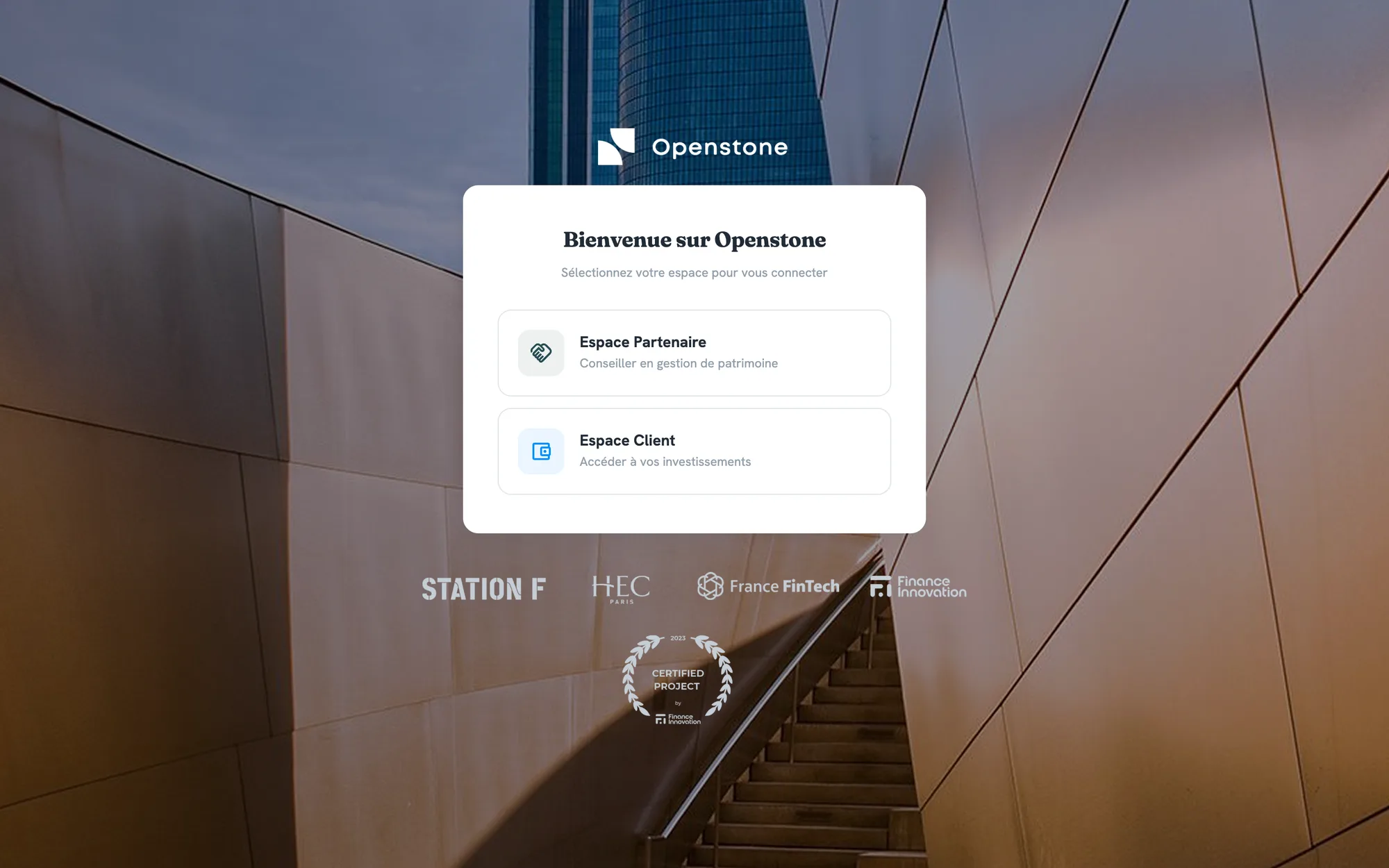
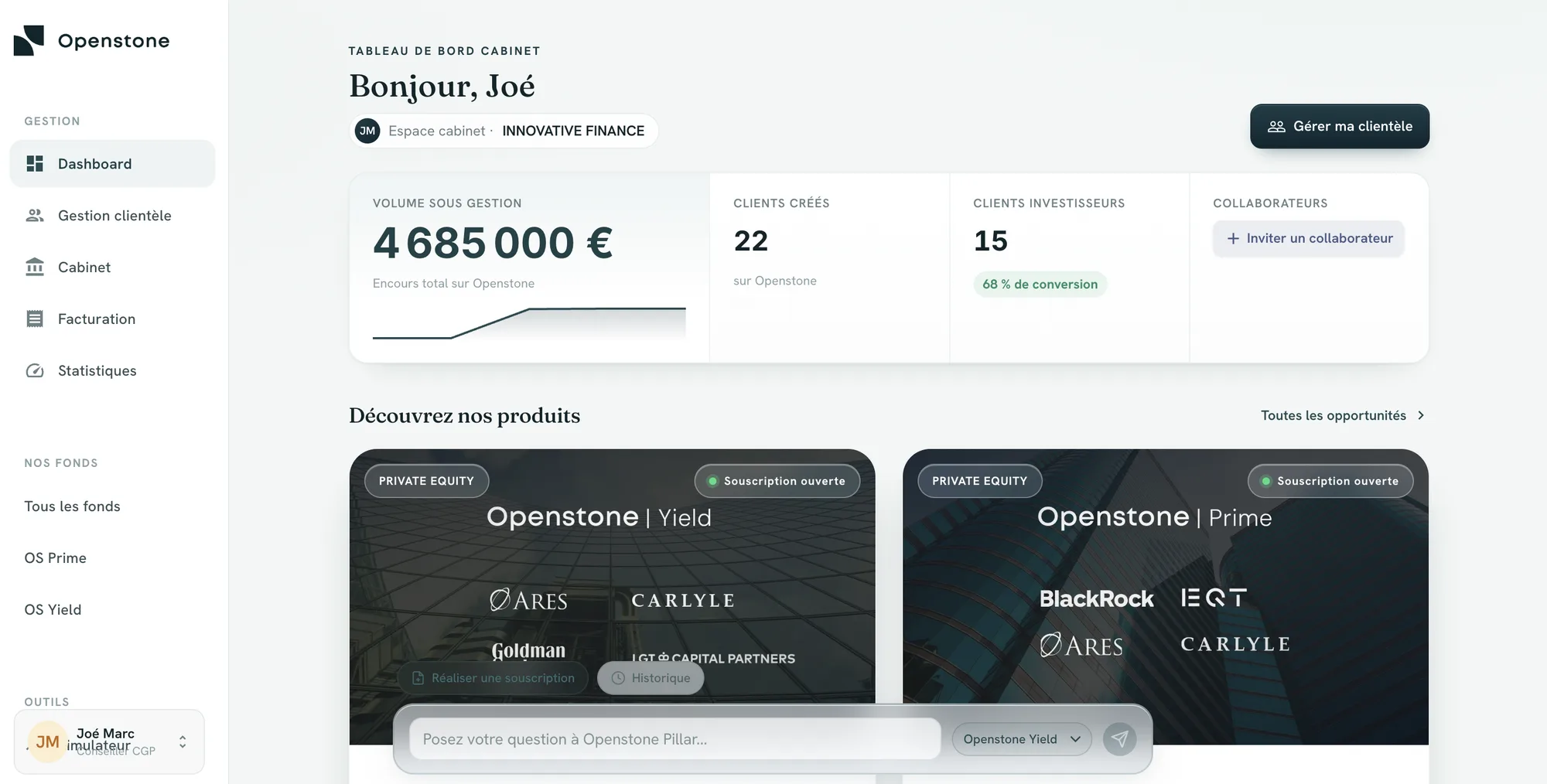
Platform screenshot, for illustration only. Choosing the fund and opportunities
You have access to the Openstone Yield strategy, its track record and the detail of the underlying assets. An adviser can help you align the investment with your objectives.
Platform screenshot, for illustration only. Online subscription and signature
You set your amount, complete your investor profile and sign electronically. Payment is secure and fully paperless.
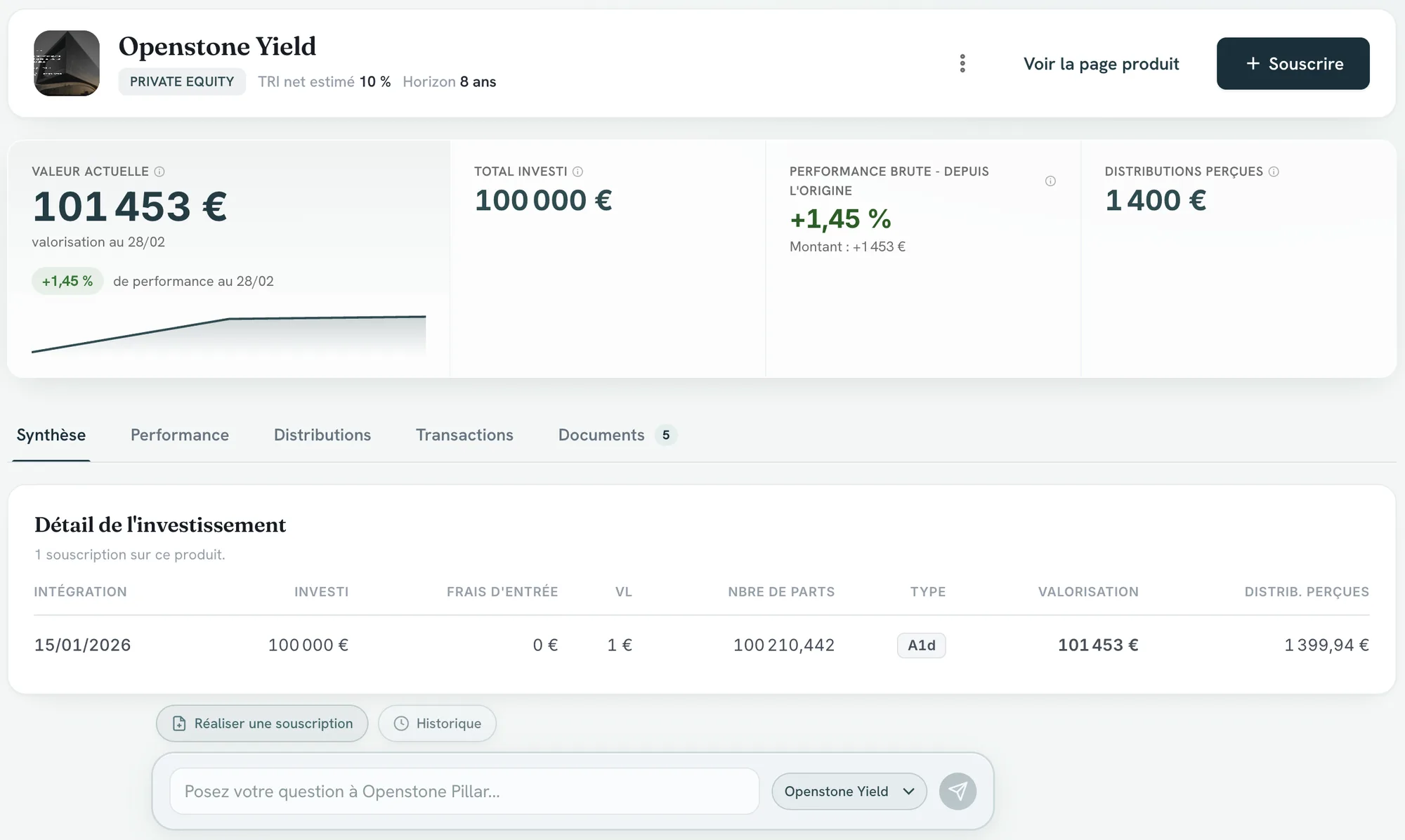
Platform screenshot, for illustration only. Monitoring in your investor area
You track performance, distributions and all your documents (reporting, statements, tax) in real time, at any moment, from your dashboard.
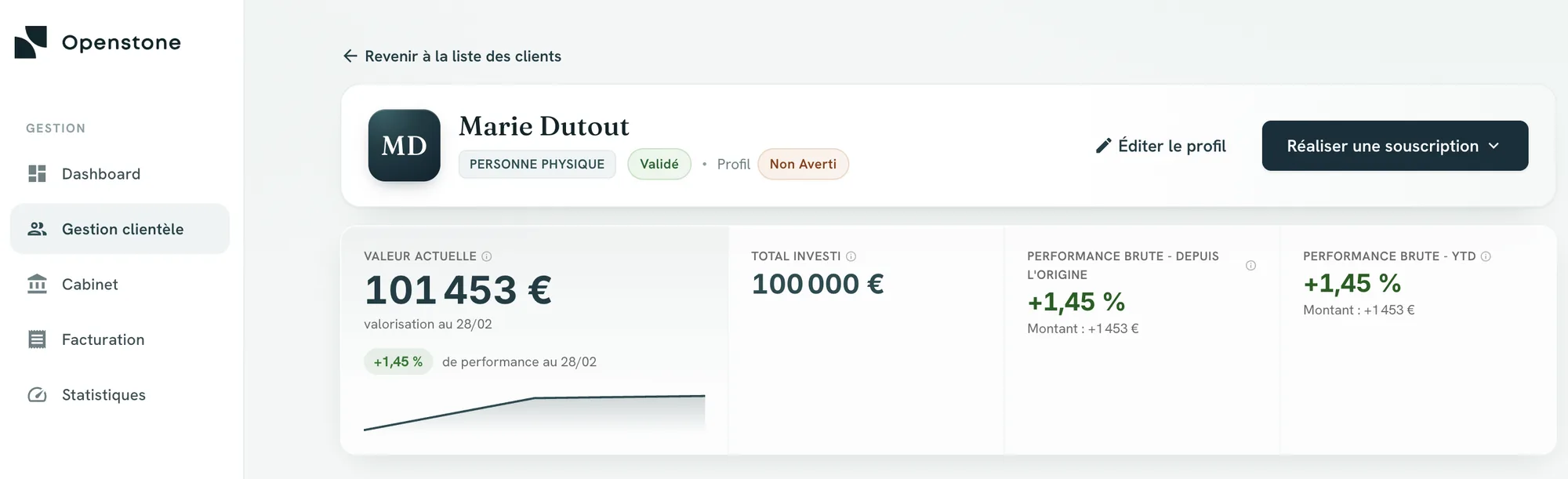
Platform screenshot, for illustration only. Distributions and exit at term
You receive any distributions. After one year of holding, you can request the redemption of your units each quarter, within the limits set out in the prospectus.

Platform screenshot, for illustration only.
Our latest articles on private debt (in French)
More articles (in French)
Comment investir son excédent de trésorerie en tant que PME / ETI ?
Private debt Nadim TakchiRead the article
 28/5/2026
Dette privée : la mer reste agitée, mais les courants européens sont favorables
Private debt Patrick JenvrinRead the article
 6/5/2026
Guide Complet sur la Dette privée pour votre trésorerie entreprise
Private debtPatrick JenvrinRead the article 25/3/2026
Dette Privée : Remettre en perspective les récents signaux de marché
Private debtNadim TakchiRead the article 24/2/2026
Le grand test : la banque d'Angleterre ausculte la Dette Privée
Private debtNadim TakchiRead the article 15/12/2025
Baisse des taux directeurs : changement de régime mais pas de rupture pour la dette privée
Private debtPatrick JenvrinRead the article

Every investor deserves access to institutional-grade investments
Openstone Yield underlines Openstone’s commitment to providing access to institutional-grade alternative offerings suited to wealth management firms. This mission comes at a time when private investors are seeking greater diversification than a traditional “60/40” portfolio provides.
FAQ
Frequently asked questions
Private debt

How should you present private debt to your executive committee or board?
You are convinced of the merits of private debt and want to persuade your board to put idle cash to work. Private debt has three structural strengths you can highlight:
1. Its low correlation with listed markets makes it a compelling source of diversification, particularly in a context of high volatility.
2. It offers greater visibility over cash flows, thanks to regular repayment and distribution mechanisms, generally quarterly.
3. As a creditor, the investor ranks ahead of shareholders for repayment, which gives private debt a more defensive positioning than equity investment.
Is it possible to exit a private debt fund early? What are the consequences?
Private debt is by nature an investment with limited liquidity: capital is committed for a defined period, and early exit is generally difficult, if not impossible.
An exit is very often accompanied by a discount on the sale price, delays in finding a buyer, a loss of return and possible additional costs.
Openstone Yield is designed to mitigate these constraints. Its portfolio combines open-ended (evergreen) funds, which provide liquidity and regular distributions, with closed-ended funds, which generally perform better. This structure allows investors to request the redemption of their units every quarter, after a one-year lock-up period. No redemption fee is charged after one year of holding. Redemptions remain capped at 5% of net assets per financial year and may be deferred or suspended. Settlement may take up to four months. The full terms are set out in Article 7.2 of the prospectus.
What role does each party play in private debt investment?
The underlying fund managers are responsible for originating opportunities, credit analysis and structuring the loans. Each manager has detailed knowledge of the markets and business models of the companies financed, and sector and legal expertise that is decisive for the quality of the portfolio.
Openstone acts as selector and allocation architect. Our role is to choose leading institutional managers, combine complementary strategies and steer the overall diversification of the portfolio. By favouring managers that each hold a privileged position in their market, we build a detailed and robust allocation for our clients.
Borrowing companies use this financing for their own growth, acquisitions or refinancing. Their operating performance underpins the repayment of the loans. Every euro lent contributes directly to the growth of the companies financed.
Investors provide the capital and receive the contractual cash flows generated by this financing. This multi-tier organisation pools risk whilst giving access to expertise normally reserved for institutional investors.
How long is my investment locked up?
Bear in mind that private debt is a long-term asset class.
For Openstone Yield, units are locked up for one year from subscription.
You should generally plan for an investment horizon of 5-8 years, with an initial deployment phase followed by the gradual repayment of the loans.
In other words, the capital is not designed to be liquid in the short term. Exit mechanisms may exist depending on the fund’s structure, but they are neither guaranteed nor immediate.
Investors should therefore regard this commitment as a locked-up sleeve of their wealth, intended to generate returns over time rather than to serve as a liquidity reserve.
The recommended holding period reflects the particular nature of this asset class. These investments are part of a long-term wealth strategy, not a short-term buy-and-sell product.
What is the minimum investment in Openstone Yield?
The standard minimum investment is €100,000.
You can also subscribe from €30,000 if you meet one of the conditions of Article 423-27 of the AMF General Regulation. You must provide technical or financial assistance to unlisted companies, assist the management company in sourcing or monitoring investments, or have private equity experience (a direct equity investment in unlisted companies, or a subscription to a specialised professional fund (FPS), a professional private equity fund (FPCI), a French venture capital fund (FCPR) subscribed without unsolicited canvassing, or an unlisted venture capital company (SCR)).
This threshold reflects the institutional nature of the fund: Openstone Yield invests in private debt funds usually reserved for large professional investors. The vehicle therefore provides access to them through a pooled minimum investment.
This ease of access is a notable advantage of Openstone’s structure, which offers a dedicated proposition for well-informed individual investors and wealth management professionals alike.
What is the average return on private debt?
Private debt has historically targeted net returns of between 7% and 12% a year, depending on the strategy, the economic cycle and the level of risk taken.
Openstone Yield targets a net IRR of 8-10% a year for the A1c unit class. This target is not guaranteed. Nor is the capital invested guaranteed. This return comes mainly from the interest paid by the companies financed. The value of the units also reflects changes in the valuation of the underlying funds. With a single investment, the fund therefore offers investors diversification, risk reduction and performance optimisation. Distribution units are available. They target distributions of 5-6% a year, not guaranteed. The amount and timing of distributions are decided by the management company.
Performance may vary from one year to the next, but the regularity sought is achievable through diversification across managers, vintage years and types of debt.
This regularity of cash flows is a well-known advantage for investors who favour predictable returns over speculative performance.
What are the real risks of private debt?
The main risk is capital loss: a company financed may run into difficulty or default. Even with collateral and priority of repayment, recovery may be only partial.
There is also a liquidity risk: the investment is not intended to be sold quickly. The capital is therefore committed for several years.
You should also bear in mind that there is:
- Economic risk (the cycle, rising interest rates, a slowdown in activity)
- Manager selection risk
- Legal and operational risk linked to private transactions
Risk control relies on diversification, the quality of credit analysis and the structuring of the loans. This is precisely the role of a fund of funds such as Openstone Yield: to pool these risks across a large number of transactions. Investors who prioritise the security of their capital should pay particular attention to the level of debt of the companies in their portfolio, and make sure that each manager has the resources needed to manage these risks.
Is private debt the most profitable investment?
No asset is objectively “more profitable” than others. Each asset class represents a trade-off between return, risk, liquidity and investment horizon.
For example, real estate private equity can generate higher gains in some vintage years, but with very wide dispersion of performance: the best funds outperform, whilst the weakest can destroy value. Private debt targets a more contractual and more predictable return.
Its profile sits in between: less volatile and less speculative than equity, but historically more rewarding than listed bonds. Unlike government bonds, whose returns are often limited, private debt offers an illiquidity premium. Private debt always prioritises stable cash flows and capital protection over the pursuit of an exceptional multiple.
It is an advantage readily recognised by investors who value stability in their wealth.
Within a wealth allocation, investing in private debt funds does not replace other assets: it complements a portfolio to improve its overall risk/return efficiency.
Who is this type of investment for?
Private debt is aimed at investors who can commit their capital over a horizon of several years and who, as with any type of investment, can accept a risk of capital loss. It can be used as a cash investment, but it is not a liquid product.
It is particularly suited to private investors seeking a higher return than traditional assets whilst reducing their dependence on listed equity and bond markets. Private debt fits naturally into a long-term portfolio construction approach.
Investors already exposed to equities, real estate or traditional funds find in it a more predictable source of supplementary income: family offices, entrepreneurs, executives and well-informed investors who value diversification use private debt as an alternative building block for diversification. Whether you are an individual looking to grow your personal savings or a business owner seeking to protect your own assets and diversify your sources of income, Openstone Yield offers a dedicated solution suited to each investor profile.
Openstone Yield is designed precisely to give access to an institutional architecture normally reserved for large investors, through a single vehicle and a professional multi-manager allocation.
Why invest in private debt?
Private debt involves financing companies directly through structured loans outside the listed markets. In return for illiquidity and a risk of capital loss, it targets a regular contractual return, paid in the form of interest, with no guarantee.
This asset class is known for capturing a lasting illiquidity premium: companies are willing to pay more for financing that is more flexible and faster than traditional bank channels. For investors, this has translated into returns historically higher than those of listed bonds.
Private debt is valued for its low correlation with financial markets. Valuations do not fluctuate daily (as on the stock market), which reduces the apparent volatility of a portfolio and will suit you if you value stability.
Loans are governed by strong legal protections (collateral, covenants, priority of repayment). Even if the company runs into difficulty, the lender sits at the top of the capital structure, and therefore ahead of shareholders. With Openstone Yield, management is diversified across several managers and strategies, further strengthening risk control that is already well established. These advantages make private debt an asset class favoured by many investors: it fits into a personal wealth diversification strategy.
What are the different types of debt?
The growth of private debt in recent years has given rise to different types of financing, reflecting the level of risk, the security attached and the term of the financing.
Senior debt: secured and senior-ranking
Senior debt gives lenders priority ranking for repayment and, in most cases, benefits from security over the underlying assets. This limits the risk in the event of borrower default. Capital lent through senior debt benefits from special protection and a privileged position in the capital structure. It is the best-placed form of corporate debt in the event of default, allowing investors to preserve their own capital whilst earning an attractive return.
Subordinated debt (mezzanine or junior debt)
Subordinated debt is repaid after senior debt, which means that in the event of default it carries a higher risk.
To compensate for this risk, investors receive higher remuneration. Additional remuneration mechanisms, such as warrants, may also apply.
Subordinated debt is therefore riskier but still ranks ahead of equity instruments (shares). It is aimed at investors who accept higher risk in return for a higher return.
Unitranche debt: a blend of senior and junior debt
So-called “unitranche” loans emerged in the early 2010s, designed to replace a combination of junior and senior debt.
Unitranche debt allows a company to deal directly with a single lender, simplifying the structuring of the financing and strengthening the relationship between the two parties. This type of financing offers greater flexibility and faster execution, thanks to tailored terms and repayment arrangements adapted to the borrower’s needs. Although more expensive than a conventional bank loan, it remains more accessible than junior financing because of its intermediate risk profile. For investors, unitranche debt carries a risk between that of senior and mezzanine debt, and is remunerated accordingly.
Why invest in private debt with Openstone?
Investing with Openstone gives access to funds usually reserved for large institutional investors (minimum investment of €10m to €20m). We select funds with strong return potential, even in uncertain economic environments, whilst enabling diversification across different types of debt (senior secured, mezzanine, unitranche, etc.) and strategies.
Our team has a privileged relationship with the world’s best managers. Our dedicated approach and full transparency in manager selection give you simplified access to corporate debt strategies normally out of reach for individual investors.
What criteria should you use to choose a private debt fund?
The main criteria for choosing a private debt fund are:
- Quality of the teams: make sure of their expertise and stability.
- Track record: check the funds’ historical performance.
- Diversification: examine the geographic and sector breakdown.
- Support for companies: favour funds that provide genuine strategic support.
Which companies are financed by private debt?
Most private debt funds finance companies under leveraged buyout (LBO) ownership (70% of the market). These companies, often among the best performers in their sector, benefit from the expertise and the security provided by the private equity funds that back them. They often operate in high-growth sectors that are well known to specialist managers. Their business models are analysed in detail before any commitment.
Why do companies turn to private debt for financing?
Private debt is generally more expensive (with rates of 5-7% above Euribor) but can be accessed more quickly than bank financing. In return, it allows companies to preserve their investment capacity, generally through bullet loans (in fine), and to access tailored financing solutions.
These solutions often follow a specialised financing approach, adapted to particular business situations, especially when a company’s debt ratio does not allow it to access conventional bank channels. The capital lent in this way forms part of a structured, tailored financing relationship.
What are the main risks of investing in private debt?
The main risks include:
- Risk of capital loss: investing in private debt carries a risk of partial or total loss of the capital invested.
- Liquidity risk: private debt securities are not listed on a stock exchange, which can make them difficult or slow to sell.
- Credit risk: a borrower default can significantly impair the performance of the portfolio.
These risks should be assessed in detail by each investor according to their profile, taking into account their investment horizon and their ability to commit capital for the long term.
What are the advantages of investing in private debt?
- Predictable returns: investors benefit from regular, foreseeable cash flows in the form of coupons.
- Illiquidity premium: a higher return in exchange for illiquidity.
- Floating rate: coupons adjust to market rates, which limits the sensitivity of loan values but means income can rise or fall.
These features make private debt an asset class particularly valued in institutional allocations. By combining several managers, strategies and vintage years, Openstone Yield offers diversified exposure to the private debt market through a limited number of target funds.
How long does an investment in a private debt fund last?
Private debt funds are income-distributing. Barring a major incident, investors receive coupons on a predictable and regular basis throughout the life of the transaction.
These coupons, generally paid quarterly, extend over a period of 6 to 8 years, corresponding to the typical investment horizon for private debt.
An investment in private debt therefore provides investors with regular, foreseeable cash flows, unlike private equity, where the early years are devoted to capital investment before any potential gains are realised. Private equity and private debt are therefore complementary.
The holding period and the investor profile play a key role in choosing this type of investment. Unlike a simple buy-and-sell product, private debt is designed to generate regular income over the long term.
For Openstone Yield, units are locked up for one year from subscription.
What is private debt?
Private debt refers to the whole non-bank debt market, that is, financing provided by investors outside the traditional banking system.
Since the 2008 financial crisis, this sector, once described as shadow banking (or non-bank financial intermediation), has expanded significantly. Stricter regulatory requirements imposed on banks have encouraged the growth of private debt as a competitive alternative to traditional bank financing.
The global private debt market is expected to reach $2.8tn by 2029 (source: LGT Capital Partners, Preqin, September 2024). This asset class, now well known to well-informed investors, differs from conventional government bonds in its contractual nature and flexibility. Unlike government borrowing, private financing offers higher returns in exchange for an attractive illiquidity premium.