



Openstone Infraworld Global private infrastructure
Global private infrastructure
- Target net IRR
- 7-9% (not guaranteed)
- Target cash yield
- 4-6% (not guaranteed)
- Recommended holding period
- 10 years
- Minimum investment
- €100,000*
- Fund type
- FPS declared to the AMF
* From €30,000 for a well-informed investor, subject to conditions. Risk of capital loss. Return targets are not guaranteed.
Openstone Infraworld aims to capture the opportunities created by the structural transformation of global infrastructure, driven by digitalisation, rising energy needs and the renewal of existing networks.
To capture this momentum, Openstone Infraworld seeks to build a diversified, complementary portfolio of funds covering the full range of private infrastructure strategies: secondaries, debt, equity, closed-ended or evergreen funds. In return, investors accept a risk of capital loss and illiquidity.
Summary
Openstone Infraworld is an evergreen fund of funds offering access to the world’s leading infrastructure managers through a single subscription. The fund aims to give investors access, from €100,000, to an asset class historically reserved for institutional investors, with diversification across managers, strategies (secondaries, debt, equity) and sectors: digital infrastructure, transport and logistics, energy. The fund targets a net IRR of 7-9% a year (not guaranteed) for the A1c unit (and a target distribution, not guaranteed, of 4-6% a year for the distribution units) over a recommended investment period of 10 years, in return for the risks inherent in unlisted infrastructure and in the fund.

A diversified fund
With both accumulation and distribution units, Openstone Infraworld spreads the capital it receives across several leading infrastructure funds with complementary strategies. At least 15% of assets are held in money-market products, bonds and deposits to manage liquidity. Redemptions are possible twice a year (net asset values of 30 June and 31 December, with requests before 31 March or 30 September) after 2 years of holding. They may be capped at 5% of net assets per date, net of subscriptions. Four target funds are envisaged with three global infrastructure managers: Macquarie (two funds), Partners Group and Ares. These managers are neither sponsors nor partners of Openstone Infraworld: each investment remains subject to the decision of the management company, Fundcraft France.
Prospective managers
- Macquarie
- Partners Group
- Ares
Key features
Openstone Infraworld
- Fund type
- French-law FPS, declared to the AMF
- Underlying
- Global private infrastructure
- Minimum investment
- €100,000, or €30,000 subject to conditions
- Liquidity
- Half-yearly redemption after 2 years, capped at 5% of net assets
- Management company
- Fundcraft France (GP-20260008)
- Fund adviser
- Openstone (Innovative Finance SAS)
Return targets are not guaranteed. Investment in unlisted assets requires a long-term investment horizon and carries risks (capital loss, illiquidity). Non-contractual content. Investors are advised to consult their financial adviser.

Openstone Infraworld is designed to offer investors diversification into an asset class that, in our analysis, has proved resilient in periods of instability. The distribution units may pay quarterly income, not guaranteed, as decided by the management company. The fund’s objective is to generate a return (not guaranteed) while allowing long-term capital appreciation through a diversified global portfolio of infrastructure investments, in debt and equity, both primary and secondary.
Investing made simple
How an investment with Openstone Infraworld works
From opening your account to tracking your distributions, every step is designed to be simple, secure and fully online. Here is what your journey on the platform looks like, step by step.
Investing carries a risk of capital loss.
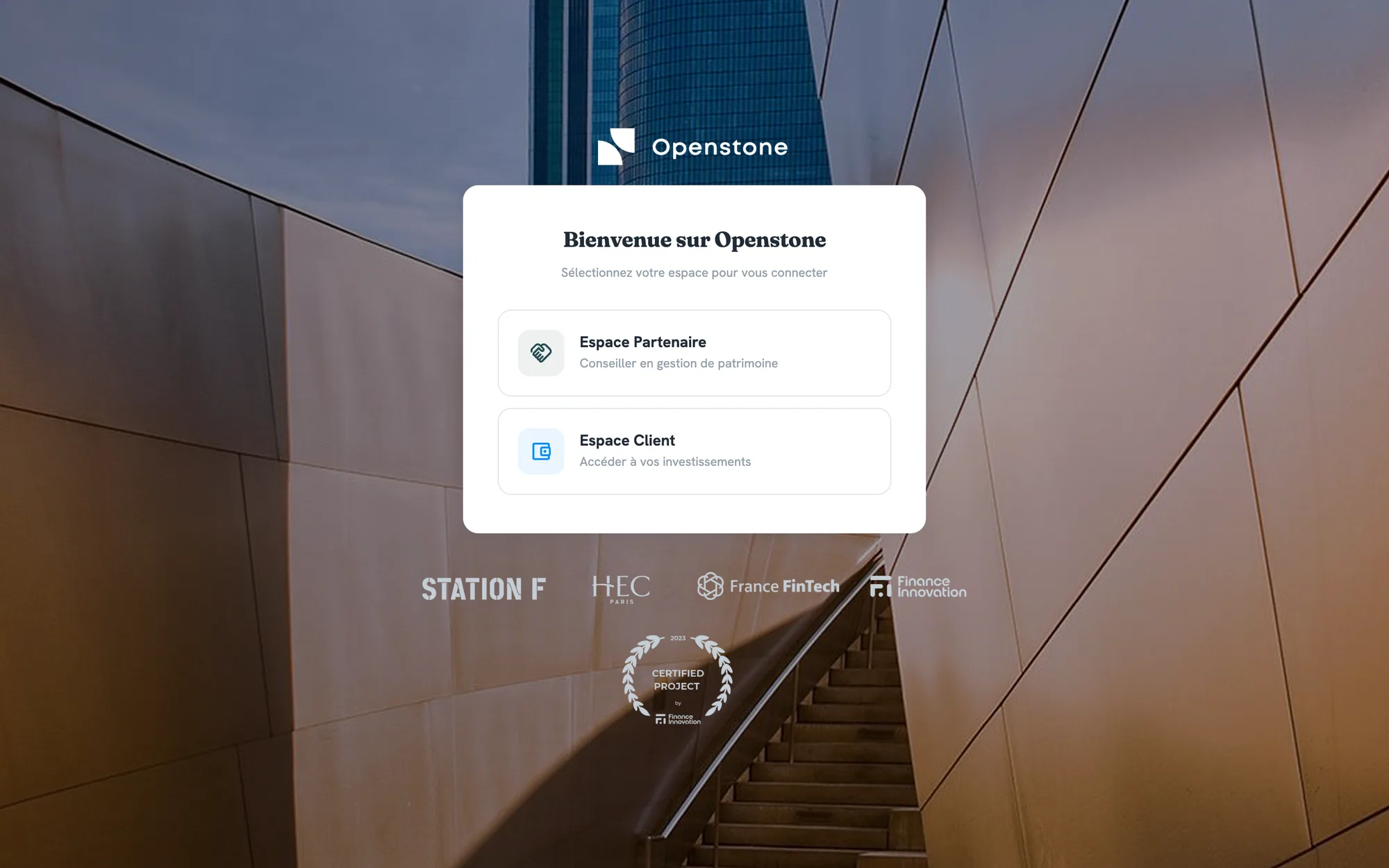
Account opening and verification
You open your account in a few minutes and verify your identity (KYC) securely. No paperwork: everything is done online, from your personal client area.
Platform screenshot, for illustration only. Choosing the fund and opportunities
You have access to the Openstone Infraworld strategy, its target allocation and the detail of the target funds envisaged. An adviser can help you align the investment with your objectives.
Platform screenshot, for illustration only. Online subscription and signature
You set your amount, complete your investor profile and sign electronically. Payment is secure and fully paperless.
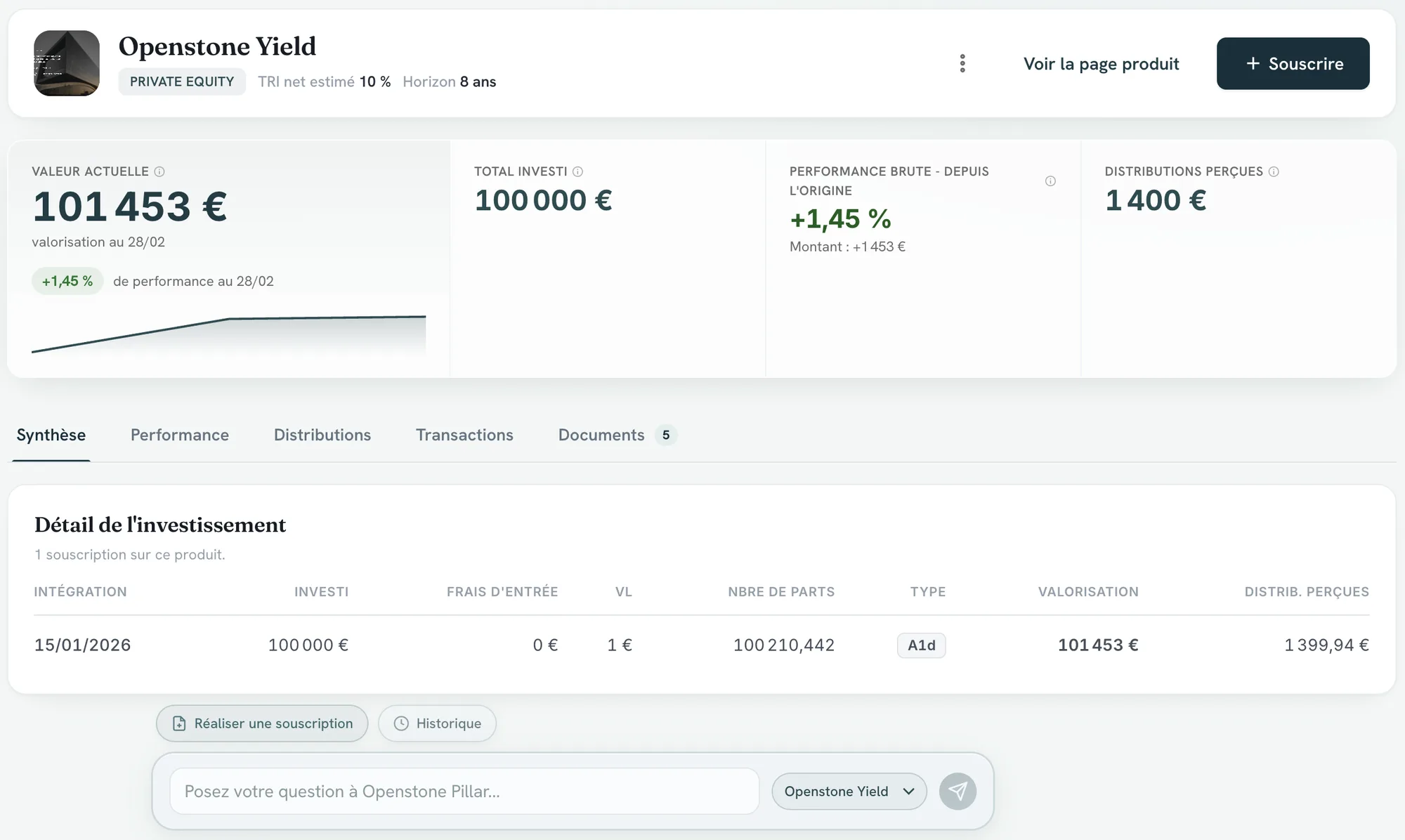
Platform screenshot, for illustration only. Monitoring in your investor area
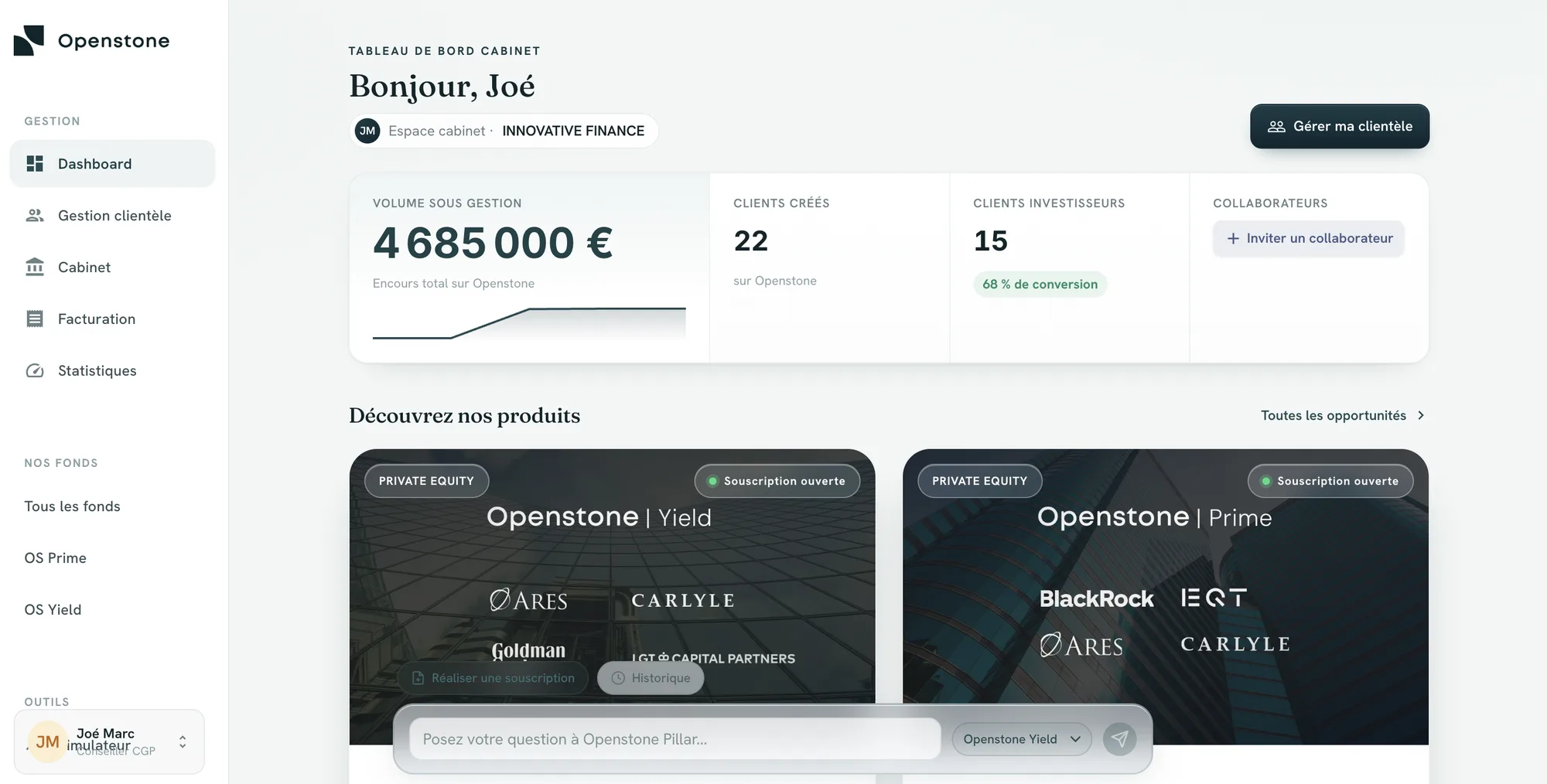
You track the monthly net asset value, distributions and all your documents (reporting, statements, tax) from your dashboard.
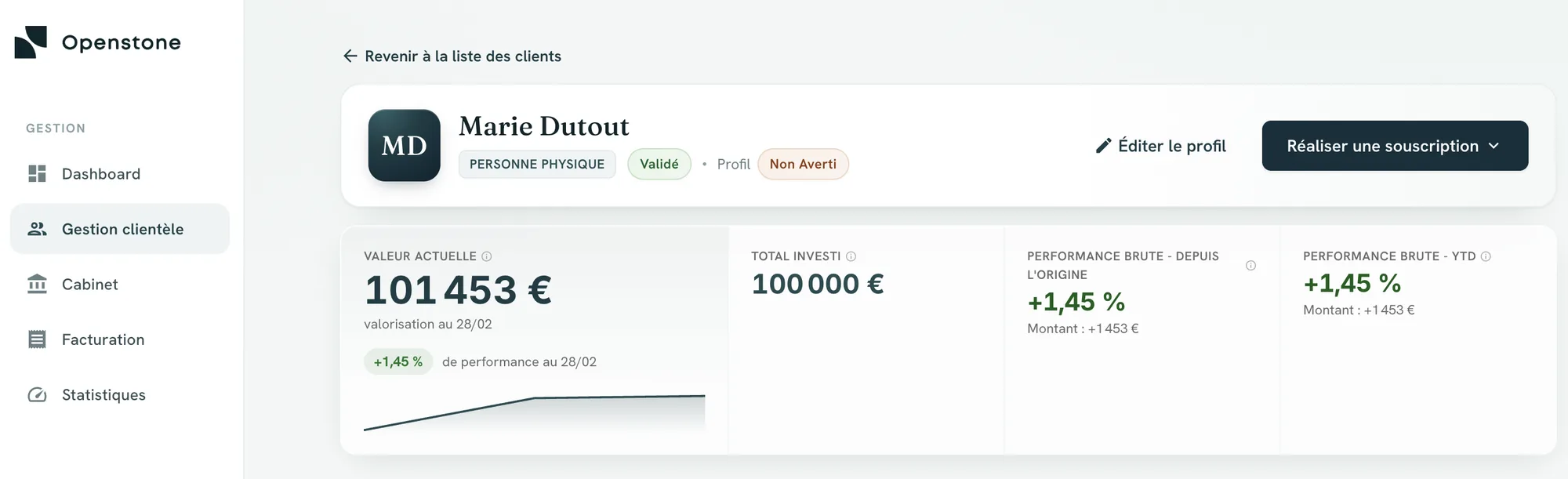
Platform screenshot, for illustration only. Distributions and exit at term
Over the life of the fund, you receive any distributions. To exit, you request the redemption of your units, possible twice a year after 2 years of holding, on the basis of the net asset value at that time. Capital is not guaranteed and redemptions may be capped or deferred.

Platform screenshot, for illustration only.
Our latest articles on private markets (in French)
More articles (in French)
L'Infrastructure privée, le troisième pilier d'une allocation
Infrastructure Nadim TakchiRead the article
 18/7/2025
Les data centers, du plutonium paré d’or ?
RessourcesNadim TakchiRead the article 14/10/2025
La récente baisse des taux sonne-t-elle le glas du duo dette privée-marché secondaire ?
Private debt Patrick JenvrinRead the article

Alternative aux foncières côtées : Quels investissements alternatifs en 2026 ?
AlternatifsPatrick JenvrinRead the article
Every investor deserves access to institutional-grade investments
Openstone Infraworld underlines Openstone’s commitment to providing access to institutional-grade alternative offerings suited to wealth management firms. After real estate private equity and private debt, the range now extends to private infrastructure, an asset class whose income rests largely on long-term contracts or regulated tariffs.
How is income distributed by Openstone Infraworld taxed?
For an individual investor who is tax-resident in France and holds units directly, taxable income distributed by Openstone Infraworld is subject to the French single flat-rate levy (prélèvement forfaitaire unique, PFU), also known as the “flat tax”.
Its overall rate is 31.4%, made up of 12.8% income tax and 18.6% social security contributions (prélèvements sociaux). Specific situations may, however, change this tax treatment: for example, opting to be taxed under the progressive income tax scale, holding the units through a company subject to French corporation tax, or the case of non-resident investors, whose taxation depends on the applicable international tax treaties.
How are the funds that make up Openstone Infraworld selected?
Openstone, as adviser to the fund, identifies and analyses infrastructure funds, then makes recommendations. The investment decision rests solely with the management company, Fundcraft France SAS. The analysis does not rely solely on past performance and covers, in particular:
- The experience and track record of the management teams
- Investment strategy and sectors
- The quality and diversification of the assets
- Risk management
- Complementarity with the other funds in the portfolio
The aim is to build diversified exposure to private infrastructure by combining several areas of expertise rather than depending on a single manager.
How does Openstone Infraworld invest in major trends such as energy, digital and transport?
Infrastructure lies at the heart of several major transformations of the economy. The energy transition requires new generation capacity and new power grids, whilst digitalisation is driving growing demand for telecommunications networks, fibre and data centres.
New forms of mobility also require significant investment in transport infrastructure.
By providing access to several segments of the market, Openstone Infraworld therefore seeks exposure to a range of long-term structural trends rather than to a single technology or sector.
How does Openstone Infraworld help diversify an infrastructure investment?
Investing directly in an infrastructure asset generally requires substantial capital and concentrates the investment on a limited number of assets.
Openstone Infraworld, by contrast, aims to spread exposure across several target funds and several infrastructure managers, with a focus on Europe. The number of target funds remains limited and the fund is concentrated solely on the infrastructure sector.
This approach means the investment as a whole does not depend on the performance of a single infrastructure asset or a single strategy. Diversification thus helps spread risk more effectively, without eliminating the risk of capital loss.
Why can infrastructure be more resilient in periods of economic uncertainty?
Even when economic activity slows, many of the services provided by infrastructure remain necessary. Electricity, telecommunications, digital networks and certain means of transport, for example, continue to be used.
This relatively stable demand can make some infrastructure assets less sensitive to economic cycles than other sectors.
They are not, however, protected against every risk. Changes in interest rates, regulatory changes, rising operating costs or a fall in demand can all affect their performance.
Why can infrastructure generate more predictable income over the long term?
Much infrastructure meets essential and lasting needs: generating electricity, communicating, travelling, transporting energy or storing data. Its use can therefore be less dependent on short-term fluctuations in consumption.
In addition, some assets benefit from long-term contracts, concessions or regulated revenues that provide greater visibility over future income. This predictability nonetheless varies from one infrastructure asset to another and is no guarantee of performance.
How can infrastructure protect income against inflation?
Some infrastructure assets have contracts or pricing mechanisms that allow their revenues to adjust to changes in prices. The tariffs charged to users may, for example, be fully or partially indexed to inflation.
This feature can help preserve the real value of income over time. It is not, however, systematic, and depends on the type of infrastructure, the contracts in place and the applicable regulatory framework.
Where does the income generated by private infrastructure come from?
Income comes mainly from the use and operation of infrastructure. A motorway may collect tolls, a telecommunications network subscriptions, whilst an energy asset may be paid for the electricity it generates or transmits.
Some assets also benefit from multi-year contracts, concessions or regulated pricing mechanisms. These business models can provide greater visibility over future income.
It is this ability to generate cash flows over long periods that is one of the main attractions of investing in private infrastructure.
What types of infrastructure does Openstone Infraworld finance?
The private infrastructure market covers many sectors that are essential to the functioning and transformation of the economy. Openstone Infraworld can provide access, in particular, to:
- Energy infrastructure: power generation, electricity grids and renewable energy
- Digital infrastructure: fibre, telecommunications networks and data centres
- Transport and mobility infrastructure
- Social and environmental infrastructure
This diversity provides exposure to several long-term growth drivers whilst avoiding concentrating the investment on a single type of infrastructure.
How does investing in private infrastructure work?
Investing in private infrastructure means investing in unlisted assets that are essential to the functioning of the economy: energy networks, transport, telecommunications, digital infrastructure and other essential facilities.
These assets generate income from their operation, for example through long-term contracts, concessions, subscriptions or regulated tariffs. Investors are therefore exposed both to the income generated by these assets and to their potential for appreciation over time.
Investing in private infrastructure is generally a long-term undertaking.