





EUROPEAN REAL ESTATE PRIVATE EQUITY
Openstone Prime
European real estate private equity
- Target net IRR
- 10% (not guaranteed)
- Recommended holding period
- 10 years
- Minimum investment
- €100,000*
- Fund type
- FPS declared to the AMF
* From €30,000 for a well-informed investor, subject to conditions. Risk of capital loss. Return targets are not guaranteed.
Openstone Prime aims to capture the opportunities created by the unprecedented real estate downturn under way since 2022. The world’s most experienced real estate managers currently have the chance to acquire quality assets at observed discounts of 20 to 40% (discounts observed by the selected managers on the transactions they have analysed, relative to the 2021-2022 cycle-peak valuations; indicative range).
To capture this window of opportunity, Openstone Prime seeks to build a diversified portfolio of institutional-grade funds. In return, investors accept a risk of capital loss and illiquidity.
Openstone Prime on video
Patrick Jenvrin, Chief Investment Officer, presents how the fund is built, the selected managers and the terms of access. (Video in French.)

Summary
Openstone Prime is an evergreen fund of funds giving access to the strategies of the world’s most experienced managers in real estate private equity. The fund aims to give investors access, from €100,000, to an asset class historically reserved for institutional investors, with diversification across real estate strategies, vintage years, risk/return profiles and managers. The fund targets a net IRR of 10% (not guaranteed) over a recommended investment period of 10 years, in return for the risks inherent in real estate private equity and in the fund.

A diversified fund
Openstone Prime seeks to capitalise on the opportunities created by the repricing of the European real estate market under way since 2022. The fund focuses on Value-Add and Core-Plus strategies, investing in assets with revaluation potential through an improved rental profile and long-term value creation. The fund spreads the capital it receives across several leading funds with complementary strategies, such as Ares, BlackRock, EQT and Carlyle.
Selected managers
- Ares
- BlackRock
- EQT
- Carlyle
Key features
Openstone Prime
- Fund type
- FPS, specialised professional fund
- Underlying
- European real estate private equity
- Minimum investment
- €100,000, or €30,000 subject to conditions
- Liquidity
- Annual redemption after 3 years, 5% discount before 5 years
- Management company
- Tygrow (GP-20226)
- Fund adviser
- Openstone (Innovative Finance SAS)
Return targets are not guaranteed. Investment in unlisted assets requires a long-term investment horizon and carries risks (capital loss, illiquidity). Non-contractual content. Investors are advised to consult their financial adviser.

The real estate downturn is offering investment opportunities we have not seen since 2008. That is why we have selected institutional-grade funds from the most experienced managers. Unlike retail funds, they are best placed to benefit from the repricing under way and can position themselves across every asset type and every transaction size.
A fully digital platform
Openstone makes life simpler for wealth management professionals
From opening your account to data aggregation, every step is designed to be simple, secure and fully online.
Investing carries a risk of capital loss and illiquidity.
Opening your partner area
You create your partner access in a few minutes and upload your partnership documents securely. No paperwork: everything is done online, from your partner area.
Open my partner area
Platform screenshot, for illustration only. Access to fund documentation
You have access to all the relevant documents and reports. The Openstone team supports you day to day.
Contact the team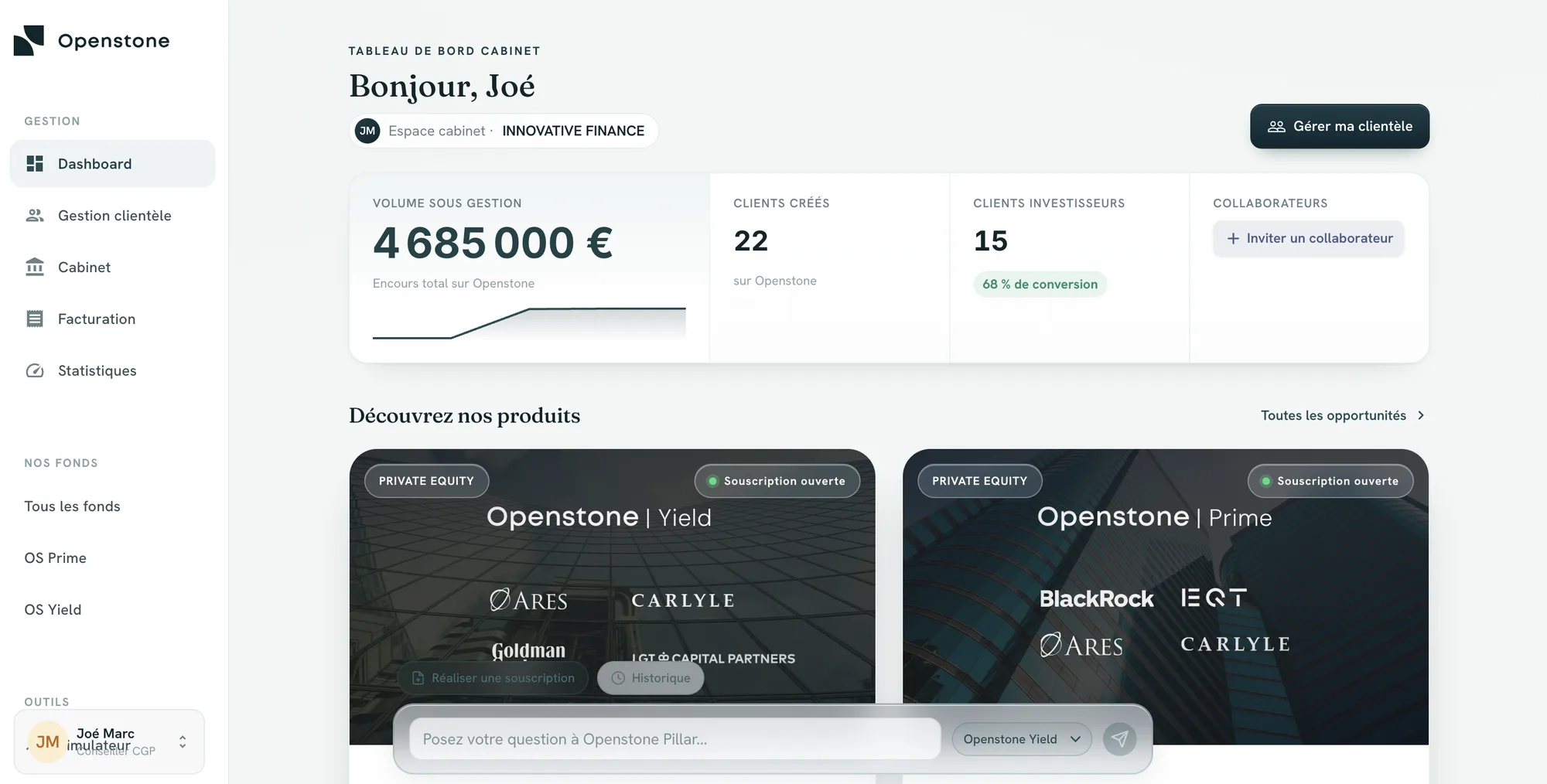
Platform screenshot, for illustration only. Online subscription journey and signature
You follow a fully digital, secure journey, with electronic signature of documents.
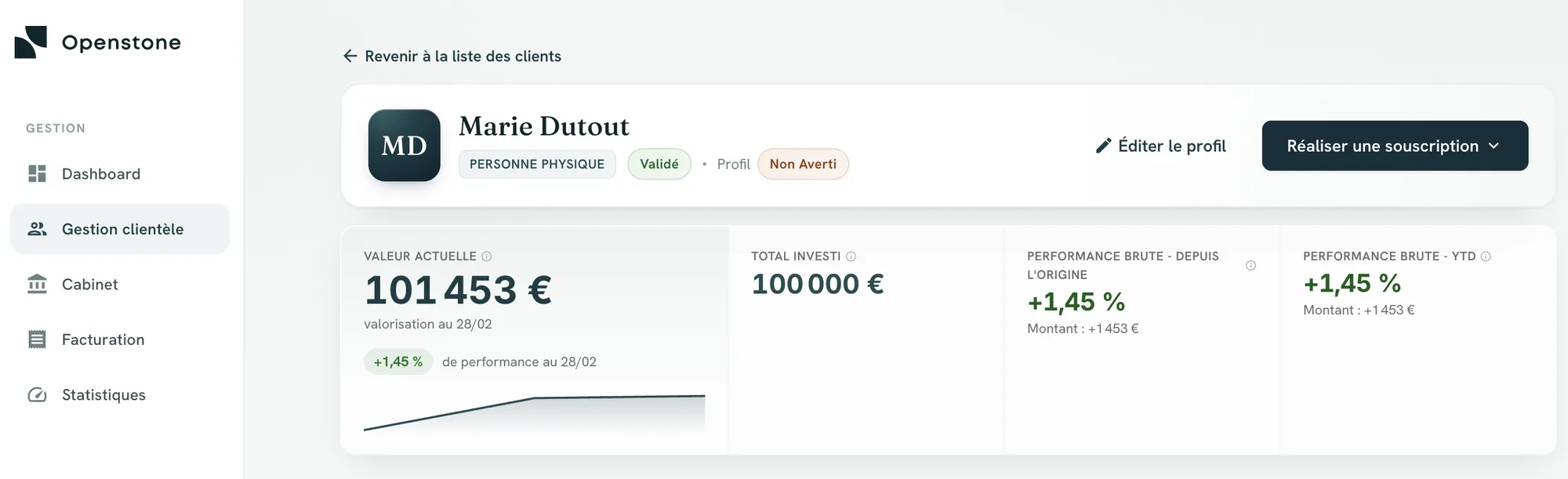
Platform screenshot, for illustration only. Monitor and manage your clients in your area
You monitor your clients’ contracts and access their documents (reporting, statements, tax) as soon as they are published. Openstone Prime’s net asset value is calculated quarterly.
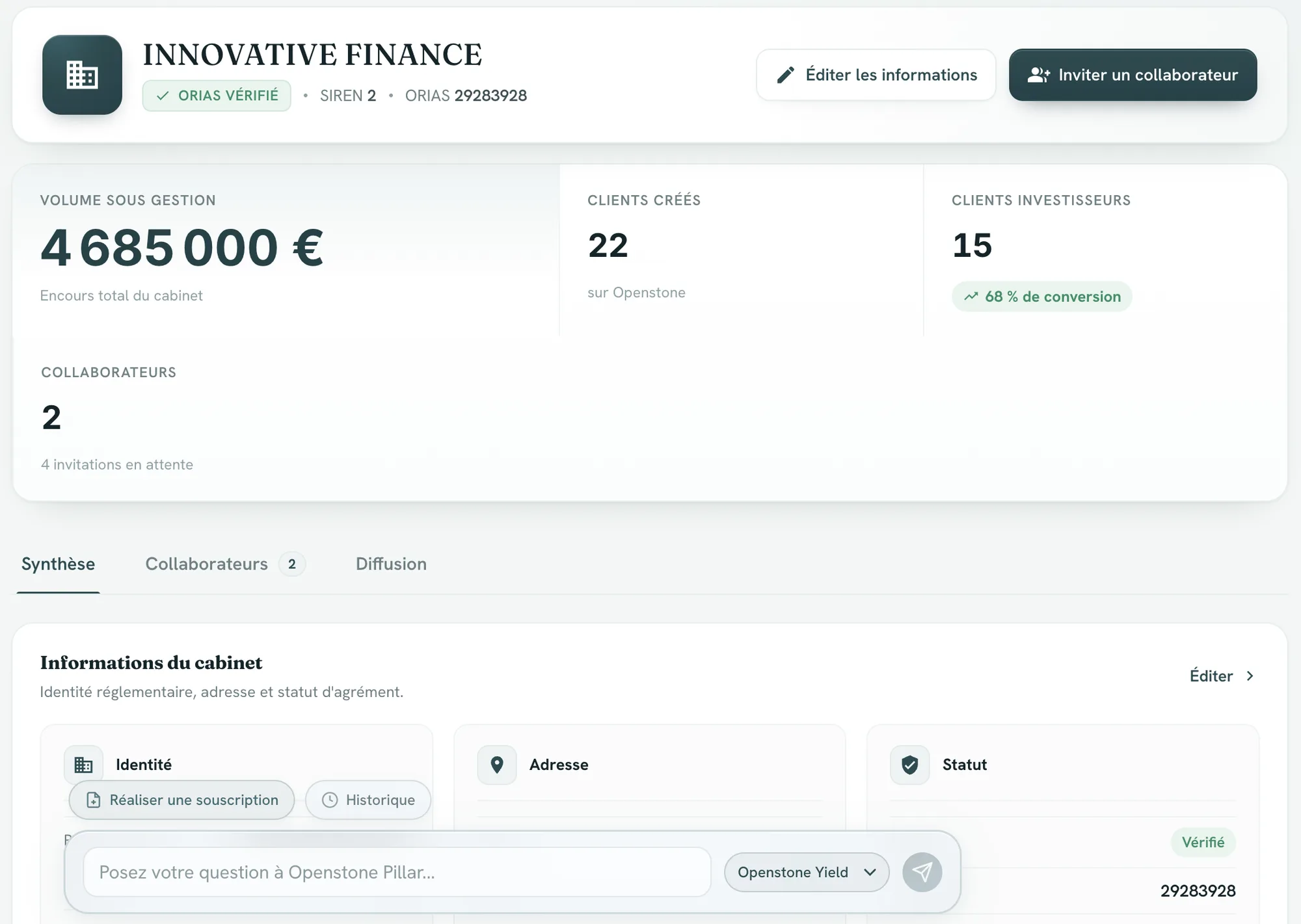
Platform screenshot, for illustration only.
Our latest articles on real estate private equity (in French)
More articles (in French) 13/11/2024
Qu'est-ce que le Private Equity Immobilier ? Pour qui ? Pourquoi ?
Real estate private equity Nadim TakchiRead the article
 30/6/2026
La résidence étudiante, nouvelle frontière de l'immobilier européen ?
Real estate private equity Patrick JenvrinRead the article
 23/4/2026
Marchés immobiliers 2025 et perspectives 2026 : la mer se calme, mais la navigation reste technique
Real estate private equityPatrick JenvrinRead the article 14/1/2026
Les cycles immobiliers font la météo, le value-added règle la voilure.
Real estate private equityNadim TakchiRead the article 12/11/2025
L’immobilier résidentiel, placement refuge devenu mirage ?
Real estate private equityRead the article
Investir en Private Equity ou en Private Equity Immobilier pour 2026 : lequel est le plus rentable ?
Real estate private equityPatrick JenvrinRead the article
OPCI vs Private Equity Immobilier : Quel investissement est le plus rentable en 2026 ?
Real estate private equityNadim TakchiRead the article

Every investor deserves access to institutional-grade investments
Openstone Prime brings a new approach to real estate investment. Combining selectivity with the pursuit of performance, it allows financial advisers to offer their clients an alternative to traditional assets.
FAQ
Frequently asked questions
Real estate private equity

Should you choose real estate private equity or other forms of investment?
Choosing real estate private equity will depend above all on your investment objectives, your risk profile and your time horizon. Compared with SCPIs, OPCIs (French retail real estate funds) or real estate crowdfunding, real estate private equity offers significantly higher return potential, thanks to active management and sophisticated strategies.
| Investment type | Return potential | Liquidity | Accessibility | Management | Tax treatment |
|---|---|---|---|---|---|
| Real estate private equity | High (10-15%, or more) | Low (5-10 years) | From €100,000 (Openstone) | Active | Optimised through legal structures |
| SCPI (French unlisted real estate investment company) | Moderate (4-6%) | Variable (units may be queued awaiting redemption) | From €1,000 | Passive (delegated) | Taxed as French property income (revenus fonciers) |
| OPCI (French collective real estate investment fund) | Moderate (4-5%) | Good | From €1,000 | Mixed | Advantages when held through French life insurance (assurance-vie) |
| Real estate crowdfunding | High but variable (6-10%) | Low to medium | From €100 | Project by project | 31.4% French flat tax (PFU), losses may be offset |
| Bare ownership (nue-propriété) | Gain on resale (no rental income) | Low (limited secondary market) | Generally from €50,000 | None (managed by the usufructuary) | No taxable income |
| Listed property companies (SIIC, French REITs) | Variable (dividends + capital gains) | Excellent (stock market) | From the price of one share | Professional (property company) | 31.4% French flat tax (PFU) (12.8% + 18.6%) on dividends and capital gains |
It is best suited to investors seeking to diversify their wealth with strong potential for value creation. Within this framework, investment strategies are tiered by risk/return level:
- Core (secure assets and moderate returns)
- Core-plus (solid assets with growth potential)
- Value-add (assets requiring refurbishment and active management to create value)
- Opportunistic (complex or distressed projects, high risk but with high potential returns)
What are the limitations and risks of real estate private equity?
Real estate private equity, also known as private equity real estate (PERE), also has limitations to take into account:
- Low liquidity (medium- to long-term commitment)
- A high entry threshold (€10m or more directly, €100,000 via Openstone)
- Specific risks linked to the quality of management, market conditions and performance that varies from one fund to another
You should be aware that the capital invested is not guaranteed and that past performance is not a reliable indicator of future results.
Openstone advises Openstone Prime, a fund of funds managed by Tygrow, which spreads the investment across several managers. The risk of capital loss and illiquidity remains.
What are the tax advantages of real estate private equity?
For an individual who is tax-resident in France, capital gains are in principle subject to the French single flat-rate levy (prélèvement forfaitaire unique, PFU) of 31.4%, made up of 12.8% income tax and 18.6% social security contributions, or, by election, to the progressive income tax scale. With accumulation units, tax is in principle payable on exit from the investment.
For a company subject to French corporation tax (impôt sur les sociétés, IS), capital gains and income are in principle taxed at the standard IS rate.
Tax treatment depends on each investor’s individual circumstances and may change. We recommend that you consult your tax adviser.
Who is real estate private equity investment for?
Historically reserved for institutional investors and the very wealthy, real estate private equity is now accessible to qualified individual investors through Openstone.
It is particularly aimed at institutional investors (pension funds, insurance companies, sovereign wealth funds, family offices), independent wealth advisers and HNWIs (high-net-worth individuals, i.e. individuals with substantial net assets).
Openstone also enables investors who meet the conditions of Article 423-27 of the AMF General Regulation to invest from €30,000.
Why should you invest in real estate private equity?
Investing in real estate private equity offers several decisive advantages:
- High return potential (target net IRR of 10% for Openstone Prime, not guaranteed)
- Portfolio diversification through access to exclusive and complex real estate assets
- Active, professional management by long-established global managers
- Low correlation with traditional financial markets
- Enhanced protection against inflation
By drawing on sophisticated value-creation strategies, investing in real estate private equity makes it possible to optimise financial performance whilst diversifying your wealth effectively.
How does real estate private equity work?
Before investing in real estate private equity, it is worth understanding how it works:
- Fundraising from institutional or individual investors, with an initial ticket of €10,000,000 (now accessible from €100,000 through Openstone Prime)
- Identification of high-potential real estate opportunities (often off-market)
- Acquisition of targeted assets by global managers
- Active management (refurbishment, operational optimisation, repositioning of properties) over the life of the project
- Exit from investments through a direct sale, a sale to a listed property company (SIIC, the French equivalent of a REIT) or a sale to specialist funds.
The aim is to achieve satisfactory returns by using operational and financial leverage.
What are the main risks of investing in real estate private equity?
The main risks of real estate private equity include:
- limited liquidity
- the possibility of a partial or total loss of capital
- a degree of dependence on the quality of asset management and on fluctuations in the real estate market
These risks are inherent in the nature of high-potential real estate private equity projects. Despite rigorous selection and in-depth expertise, unforeseen events such as an economic crisis or a downturn in the real estate market can have a negative impact on returns.
That said, on Openstone’s recommendation, the management company Tygrow invests in leading funds with complementary strategies.
How long does a real estate private equity investment last?
The average duration of your real estate private equity investment generally ranges from 5 to 10 years.
This is the time needed to see projects through to completion, including the following phases:
- Acquisition
- Value creation (refurbishment, repositioning of properties, improving rental income, etc.)
- Optimised sale of the assets
This duration makes it possible to maximise your return potential and take full advantage of real estate cycles, supported by active, professional management of the investments.
What types of real estate projects does real estate private equity finance?
Real estate private equity finances high value-add and/or long-term projects, such as the refurbishment and repositioning of existing real estate assets, or the development of complex new projects.
These investments often cover specific market segments, such as commercial buildings, logistics warehouses, increasingly sought-after facilities such as data centres, and more ambitious residential and urban projects. Openstone Prime targets undervalued assets that require asset management work, or off-market opportunities, thereby harnessing their high potential for value creation over the medium and long term.
Why invest in real estate private equity now through Openstone Prime?
Investing in real estate private equity today through Openstone Prime allows you to position yourself in a real estate cycle that has turned a corner. After a correction in real estate values of around 20-25% in Europe, the market is attracting investors again: €184bn was invested in Europe in 2024 (+17%), followed by €241bn in 2025 (+25%), according to CBRE Research (2026).
Sectors such as residential real estate, hospitality and logistics continue to attract strong interest from international investors, who are looking to take advantage of attractive price levels across different European jurisdictions. We therefore expect cross-border investment activity to increase over the next 6-12 months.
By choosing Openstone Prime, you benefit from broad diversification. With a single investment, Prime allows you to diversify your assets on several levels: by manager, country, asset type, tenant, asset size and investment strategy (value-add, core-plus, etc.). This approach allows you to reduce risk whilst optimising your return prospects.
What is real estate private equity?
Real estate private equity focuses on the acquisition, management and sale of unlisted real estate assets. The managers’ role is to create value at every stage of the investment cycle, from acquisition through asset management to sale.
Why invest in real estate private equity with Openstone?
Investing with Openstone gives access to funds usually reserved for large institutional investors. We select funds with strong return potential, even in uncertain economic environments, whilst enabling diversification across different types of assets and strategies.